

Leipzig, Germany / Ha Noi, Viet Nam, 01 September 2025 — Under the EU-funded Accelerating Innovative Startups for Energy Efficiency (AIS4EE) project, the Training-of-Trainers (ToT) programme on entrepreneurship in energy efficiency completed a four-day field study at Leipzig University’s Small Enterprise Promotion and Training (SEPT) Center. Held in Leipzig, Germany from 23-30 August, this second part of the first batch of the ten-day ToT programme is a continuation of the training kicked off in June in Hanoi, providing selected participants with exposure to advanced innovation ecosystems, research and development models, and startup support mechanisms for energy efficiency in Germany.

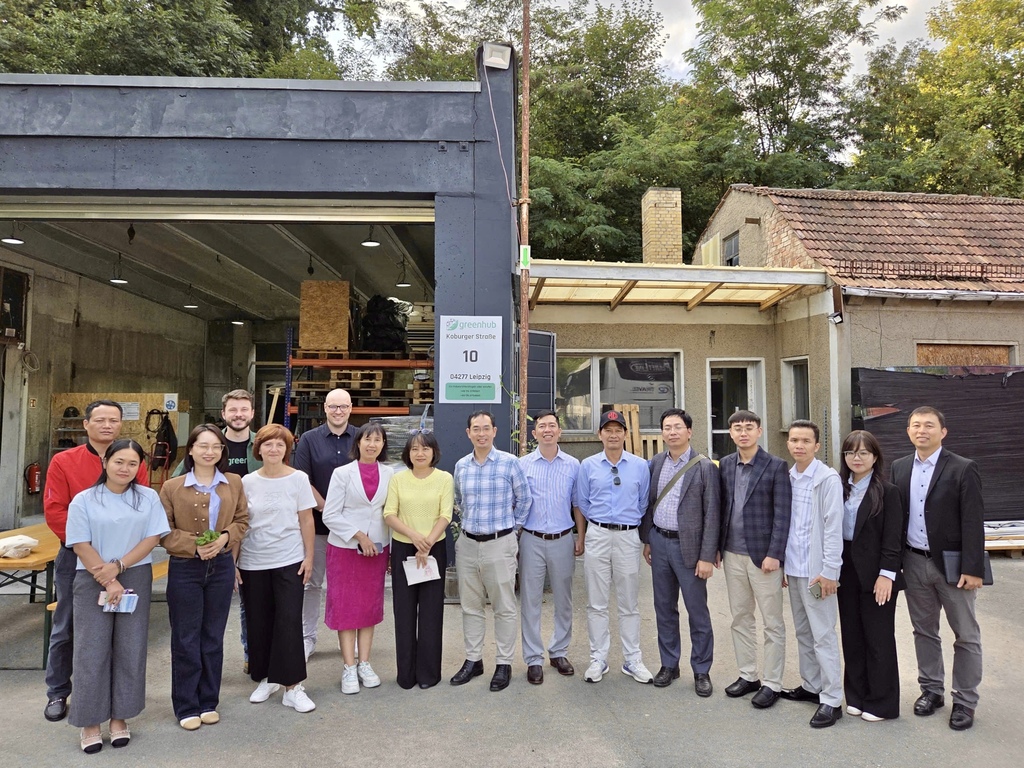
Introductory meetings with European Energy Exchange (EEX) and Greenhub. Photo: GGGI
The delegation, led by the Agency for Innovation, Green Transition and Industry Promotion (IGIP) under the Ministry of Industry and Trade (MoIT), in collaboration with the GGGI Viet Nam Office and Ho Chi Minh City Center for Innovative Startups (SIHUB), comprised 13 government officials and selected lecturers and trainers from universities and innovation centers nationwide.
Structured as a hands-on learning block within the ToT, the Leipzig segment focused on entrepreneurial approaches to energy efficiency innovation. Participants advanced through business model design and validation; financial planning and growth strategy; and investor readiness—covering the roles of angels and Venture Capitals, pitching practice, and exit pathways. An introductory session at SEPT’s Process Living Lab demonstrated process mapping, motion-tracking and virtual reality simulation to analyze workflows and quantify efficiency and productivity gains. The segment included ecosystem mapping and EU–Viet Nam comparisons to adapt these methods to local procurement and university settings.
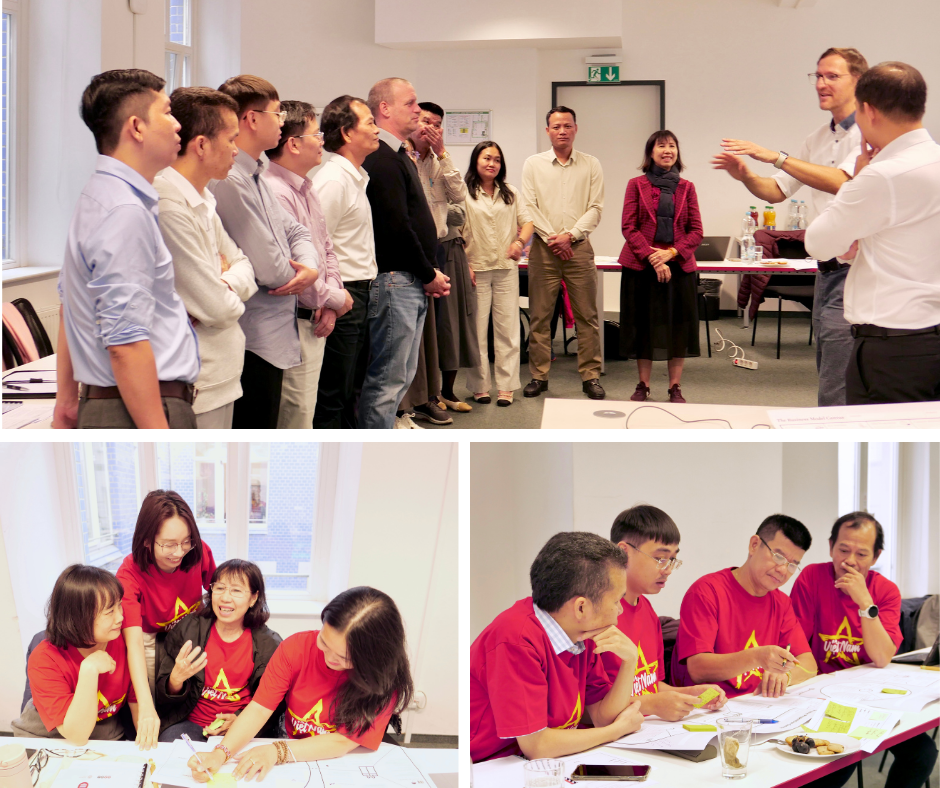
Photos: GGGI
As part of the study trip, the delegation engaged with startup and energy ecosystem touchpoints that reinforced the learning, including SpinLab (HHL)— one of the top European accelerators, offering sector-focused, non-dilutive programmes that connect startup founders to corporate buyers and city partners to shorten the path from pilot to scale—and the European Energy Exchange (EEX), a leading global energy exchange platform for energy products, emissions and other commodities.
Mr. Nguyen Quang Huy, Deputy Head of Division, International Cooperation & General Affairs at IGIP who led the Vietnamese delegation, emphasised that collaboration is essential to innovation and that lessons from Leipzig University are timely for Viet Nam’s startup ecosystem—especially energy-efficiency ventures.
Exploring Leipzig’s startup scene, the delegation examined Greenhub’s data-driven indoor-farming platform, with AI features, that optimises growing conditions to raise yields while reducing energy and resource use; Re:leaf’s use of satellite imagery and AI to map heat-island and flood risks and translate analysis into practical solutions; and the case of Glashaus 3D on how rapid prototyping and manufacturing design choices influence both productivity and energy footprints.
Professor Utz Dornberger, Director of the International SEPT Competence Center underscored that Leipzig University’s mission extends beyond teaching and research to transferring knowledge into the economy.
This ToT programme forms part of AIS4EE’s ecosystem-building effort in Viet Nam—providing participants with the knowledge, tools, and teaching approaches to support early-stage entrepreneurs and help mainstream energy-efficiency innovation in training and academic institutions. The direct engagements highlighted the vibrancy of Leipzig’s entrepreneurial community and opened avenues to connect Viet Nam–Germany startup ecosystems for future collaboration.
Under the EU – Viet Nam Sustainable Energy Transition Programme (SETP*), AIS4EE project is funded by the European Union (EU), hosted by the MOIT, and co-funded and implemented by GGGI. The Leipzig field study was delivered in collaboration with Leipzig University’s SEPT Center and consortium of SIHUB and RCEE-NIRAS Joint Stock Company.
——–
*Note: The EU and the Government of Viet Nam are working together on a sustainable energy transition in Viet Nam. For this purpose, the EU and the Government of Viet Nam adopted the SETP on 31 December 2021. This joint programme re-affirms the EU’s close cooperation and long-term commitment to Viet Nam’s goal of sustainable energy transition towards net-zero by 2050.
The SETP, with an EU grant of EUR 142 million, will be implemented from 2022 to 2027. It follows the success of the EU – Viet Nam Energy Sector Policy Support Programme, a EUR 108 million grant by the EU for Viet Nam implemented from 2018 to 2021. For more information, please visit: https://setp.vn/about-setp/
Views: 95
