

The Multi-Hazard Management Project for the Nam Rom River Basin, with a total investment of VND 981 billion, is being implemented using a risk-management approach that combines disaster prevention infrastructure with climate adaptation.
Facing risks along the Nam Rom River basin that directly affect the daily lives of residents, Dien Bien Province has launched the Multi-Hazard Management Project with financial support from the European Union (EU), the French Development Agency (AFD), and counterpart funding from the local government.
Instead of focusing on individual structures, the project adopts an integrated risk-management approach that combines disaster prevention infrastructure with strengthened management capacity and climate change adaptation.
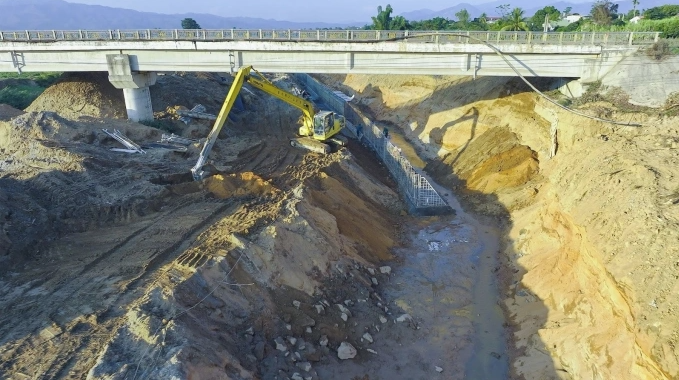 The Multi-Hazard Management Project for the Nam Rom River Basin, supported by the European Union (EU) and the French Development Agency (AFD), introduces a new approach to disaster risk management. Photo: TAJ Vietnam
After five years of implementation, the embankment system reinforcing both riverbanks has largely been completed. Riverfront areas that were previously degraded and disorganized have been upgraded into stone-paved walking paths with lighting and green landscaping, creating new public spaces for local residents.
Alongside the embankment system, the project is implementing additional components such as water-retaining dams, river flow regulation works and temporary flood storage areas. These measures aim to regulate water flows during the rainy season while ensuring water supply for agricultural production in the dry season.
Local residents say these improvements have helped reduce the risk of landslides while also making daily life and production activities more convenient.
In parallel with infrastructure development, the project is also building an early warning system and a Decision Support System (DDS). The system will enable real-time monitoring of hydrological data and support local authorities in making timely response decisions when disaster risks arise.
From a development cooperation perspective, the Nam Rom River Basin project forms part of the European Union’s broader efforts to support Vietnam in strengthening resilience to climate-related risks.
Kristina Buende, Head of Cooperation at the European Union Delegation to Vietnam, said integrated multi-hazard risk management projects help protect the foundation of Vietnam’s green transition by reducing disruptions and losses caused by climate impacts.
According to her, adaptation initiatives such as the Nam Rom project support the Net Zero objective not by directly cutting emissions, but by ensuring that climate shocks do not undermine long-term emission-reduction efforts and sustainable development pathways.
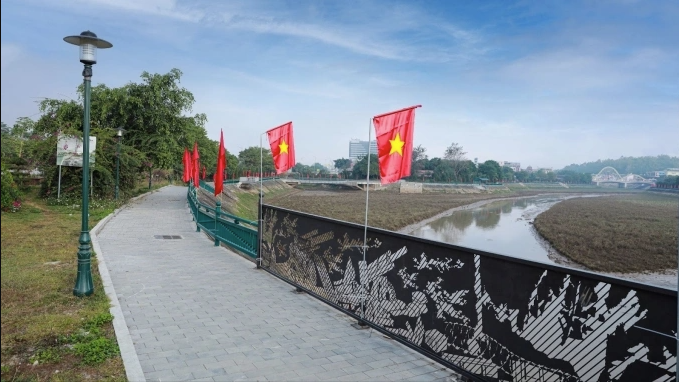 The embankment system reinforcing the riverbanks has largely been completed. Photo: TAJ Vietnam
Located in the Dien Bien basin, Dien Bien Phu City (prior to administrative restructuring) is surrounded by mountain ranges and upstream river systems. Among them, the Nam Rom River is one of the most important waterways in the region.
The river originates in the northern mountainous area of the province, flows through the center of Dien Bien Phu City, before joining the Nam Nua River and eventually flowing into the Mekong River system.
Stretching about 35 kilometers, the Nam Rom River plays a vital role in the livelihoods and production activities of local residents. Water from the river irrigates rice fields across the Dien Bien basin and supplies water to riverside communities.
However, in recent years, the impacts of climate change and increasingly extreme rainfall events have made the river’s behavior less predictable.
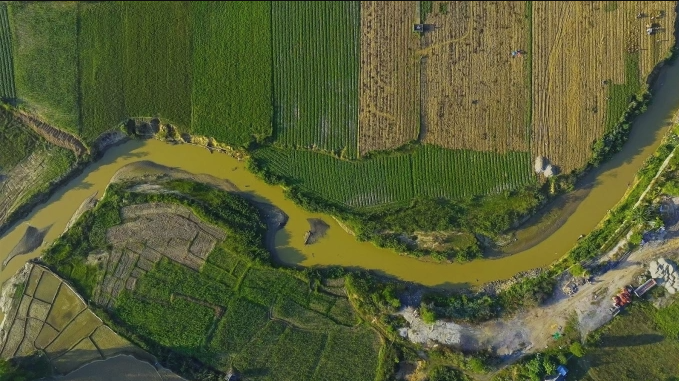
The Nam Rom River has long been closely connected to the livelihoods and production activities of residents in the Muong Thanh basin, Dien Bien. Photo: TAJ Vietnam
Residents who have lived along the river for many years say the flow of the Nam Rom River has changed over time. Riverbanks that were once stable have begun to experience erosion, particularly during periods of heavy rainfall and flooding.
Nguyen Thi Lien, head of Hamlet C9 (now part of Muong Thanh Ward in Dien Bien Province), said local residents have lived with these concerns for years.
“Whenever the rainy and flood season comes, the river water rises and erosion occurs,” she said. “In the past the river flowed farther away, but over time it has gradually moved closer to the residential area.”
She added that at times floodwaters rose so high that many households faced the risk of losing farmland, livestock facilities being washed away, and even threats to riverside homes.
“In some years, when heavy rain lasted for days, local authorities had to prepare evacuation plans to ensure people’s safety,” she said.
In that context, finding long-term solutions to regulate river flows and reduce disaster risks has become an urgent priority for communities living along the Nam Rom River basin.
The European Union is a key partner supporting Vietnam’s green transition and sustainable development through initiatives promoting clean energy and strengthening community resilience to climate change.
Learn more about cooperation initiatives and stories of change from EU-supported projects across Vietnam.
Source: VnExpress
Views: 309
